
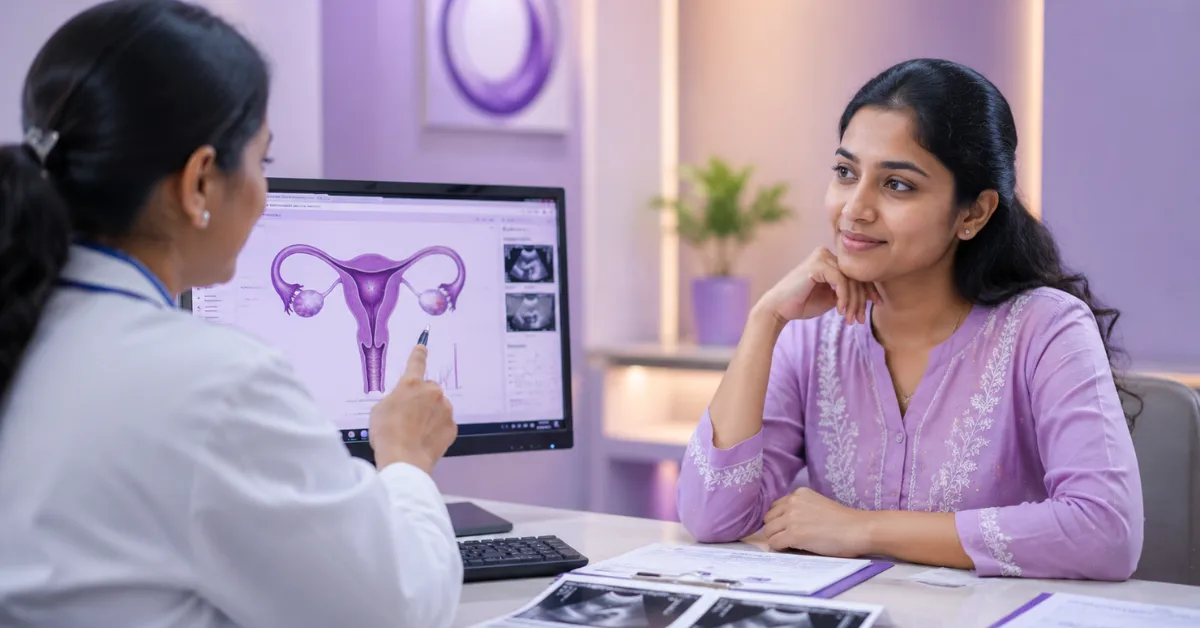
Starting your fertility journey can feel overwhelming. At THAAIMAI Hospital in Alwarpet, Chennai, we make it simple and reassuring. Our fertility assessments & diagnostics are designed to give you clear answers about your reproductive health — without unnecessary confusion or delay.
When a couple is trying to conceive, the first and most important step is understanding what is actually happening inside the body. A thorough evaluation looks at hormonal health, reproductive organs, ovulation patterns, and sperm quality. This gives our specialists the full picture they need before suggesting any next steps.
We believe that every person deserves accurate information about their own body. Getting tested is not a sign of failure — it is the smartest way to move forward with confidence.
Many couples spend months or even years trying to conceive without knowing there is a medical reason behind the delay. A proper fertility assessment helps identify these reasons early.
Common issues that a diagnostic evaluation can uncover include blocked fallopian tubes, hormonal imbalances, low sperm count, ovulation problems, and uterine abnormalities. Once the cause is found, treatment becomes far more focused and effective.
At THAAIMAI Hospital, we do not guess — we investigate. Our goal is to give you a diagnosis that is specific to your situation, not a generic checklist.
Individualized Diagnostic Approach for Couples
No two couples are the same. A woman who has irregular periods has different diagnostic needs compared to someone who has regular cycles but still cannot conceive. Similarly, male fertility factors vary widely from person to person.
That is why our fertility assessments & diagnostics for women and their partners follow an individualized path. We look at your medical history, your lifestyle, your age, and your test results together — and build a plan that fits you specifically. This approach leads to faster answers and better outcomes.
Infertility affects both men and women, and in many cases, both partners have contributing factors. Understanding the root cause is the foundation of effective treatment.
Female-Related Infertility Factors
Several conditions in women can affect the ability to conceive naturally. The most common ones include:
These conditions are diagnosable through the right combination of blood tests, ultrasounds, and clinical evaluation.
Male-Related Infertility Factors
Male infertility is responsible for around 40 to 50 percent of all infertility cases, yet it often goes undiagnosed for too long. Key factors include:
A simple semen analysis is usually the first step and provides a great deal of useful information.
Lifestyle and Medical Contributors
Beyond specific medical conditions, certain lifestyle habits and general health factors can affect fertility in both men and women. Excess body weight, smoking, alcohol consumption, chronic stress, and exposure to environmental toxins all play a role.
Previous medical treatments like chemotherapy or certain long-term medications can also impact fertility. A detailed medical history taken during your consultation helps us account for all of these factors and build a complete picture.
Couple-Based Fertility Consultation
At THAAIMAI Hospital, we encourage both partners to attend the initial consultation together. Fertility is rarely a one-sided issue, and evaluating both partners from the beginning saves time and gives us a more complete understanding of the situation.
During this consultation, our specialist will listen carefully to your concerns, ask relevant questions about your reproductive history, and explain what tests are recommended and why. You will never be rushed, and you will always understand what is being done and for what reason.
Medical History and Physical Examination
A thorough medical history is one of the most valuable diagnostic tools we have. Details like the duration of trying to conceive, menstrual cycle patterns, previous pregnancies, surgeries, infections, or chronic illnesses all provide important clues.
A physical examination helps assess general health, hormonal signs, and any visible or palpable abnormalities. Together, the history and examination guide which specific tests will be most useful for your case.
Treatment-Oriented Fertility Assessment
Our fertility assessments & diagnostics in Chennai are not just about identifying problems — they are designed with treatment in mind. Every test we recommend serves a purpose in guiding the next step.
Whether the outcome points toward lifestyle changes, medication, intrauterine insemination (IUI), or in vitro fertilization (IVF), our assessment gives us — and you — the clarity needed to move forward with a well-defined plan.
Ovulation and Menstrual Cycle Evaluation
Regular ovulation is essential for natural conception. If a woman is not ovulating consistently, it significantly reduces the chances of pregnancy. Our specialists evaluate ovulation through a combination of hormonal blood tests and ultrasound scans done at specific points in the menstrual cycle.
We also assess the regularity and nature of the menstrual cycle — its length, flow, and any associated symptoms like pain or spotting — which can all point to underlying conditions.
Ovarian Reserve Testing
Ovarian reserve refers to the quantity and quality of a woman's eggs. This naturally decreases with age, but it can also be lower than expected in younger women due to medical or genetic reasons.
Testing for ovarian reserve typically includes:
These results help us understand how much time you have and which treatment path is most appropriate.
Uterus and Fallopian Tube Assessment
The uterus and fallopian tubes must be healthy and open for conception and implantation to occur. We assess the shape and lining of the uterus through ultrasound and, when needed, more detailed procedures.
Fallopian tube patency — whether the tubes are open and functioning — is evaluated through specific tests like the HSG (hysterosalpingography). Blocked tubes are a significant cause of infertility and, once identified, can often be treated.
Semen Analysis and Sperm Health Check
A semen analysis is the primary test for male fertility. It evaluates several key parameters including sperm count, motility (movement), morphology (shape), volume of semen, and pH levels.
This test is non-invasive, straightforward, and gives us a great deal of information quickly. Results are interpreted alongside other clinical findings to determine whether male factor infertility is contributing to the couple's difficulty in conceiving.
Hormonal Evaluation for Male Fertility
Hormones play a central role in sperm production. Low levels of FSH, LH, or testosterone can impair the testes' ability to produce healthy sperm. We test these hormone levels through a blood draw and assess them alongside the semen analysis results.
In some cases, elevated prolactin levels or thyroid dysfunction can also affect male fertility — these are checked as part of a complete hormonal workup.
Advanced Sperm Function Testing
When a standard semen analysis shows borderline results, or when unexplained infertility is suspected, advanced sperm function tests help us look deeper. These may include:
These tests are not routine for everyone, but they are invaluable when standard tests do not explain a couple's fertility challenges.
Reproductive Hormone Profiling
Hormones control every aspect of the reproductive process — from ovulation to implantation. An imbalance in any one hormone can disrupt this carefully timed system.
We test a full panel of reproductive hormones including FSH, LH, estradiol, progesterone, prolactin, AMH, and testosterone (in both men and women). These results are reviewed together to understand how the hormonal system is functioning as a whole.
Blood Tests for Fertility Assessment
In addition to hormonal profiles, we carry out essential blood investigations that affect fertility. These include:
Thyroid and Metabolic Screening
The thyroid gland has a direct influence on fertility. Both hypothyroidism (underactive thyroid) and hyperthyroidism (overactive thyroid) can cause irregular cycles, anovulation, and difficulty maintaining a pregnancy.
We routinely check TSH (thyroid-stimulating hormone) and related markers as part of every fertility assessment. Metabolic conditions like insulin resistance — especially in women with PCOS — are also screened, as managing these improves treatment outcomes significantly.
Transvaginal Ultrasound Scan
A transvaginal ultrasound (TVS) is a key diagnostic tool in female fertility evaluation. It uses a small probe placed internally to provide detailed images of the uterus, ovaries, and surrounding structures — all at close range and with excellent clarity.
This scan is safe, well-tolerated, and routinely performed in a clinical setting. It helps us detect fibroids, cysts, polyps, signs of endometriosis, and structural abnormalities that a standard abdominal ultrasound might miss.
Follicular Monitoring
Follicular monitoring involves a series of ultrasound scans performed across the menstrual cycle to observe the growth and release of follicles (the sacs that contain eggs). This tells us whether ovulation is occurring, when it is happening, and whether the process is normal.
This type of monitoring is particularly useful when a woman has irregular cycles, when planning timed intercourse, or when the cause of infertility remains unclear.
Uterine and Ovarian Evaluation
A detailed ultrasound evaluation of the uterus assesses its size, shape, and the condition of its inner lining (endometrium). The endometrial thickness and pattern at various points in the cycle are important indicators of whether the uterus is ready to receive and support an embryo.
Ovarian evaluation looks at the size and appearance of both ovaries, the presence of cysts, and the antral follicle count — all of which feed directly into the fertility diagnosis.
Hysterosalpingography (HSG) Test
The HSG test is an X-ray procedure that checks whether the fallopian tubes are open and the uterine cavity is normal in shape. A contrast dye is introduced through the cervix, and X-ray images track how it moves through the uterus and tubes.
If the dye flows freely through both tubes, they are considered open. If it is blocked at any point, the test reveals where and how severe the blockage is. This is one of the most important investigations in female fertility diagnostics.
Hysteroscopy for Uterine Examination
A hysteroscopy allows our specialists to directly view the inside of the uterus using a thin, lighted telescope inserted through the cervix. It is used to diagnose and, in many cases, treat conditions like:
It is a minimally invasive procedure performed under appropriate analgesia or anaesthesia and is generally well-tolerated.
Laparoscopy for Fertility Evaluation
Laparoscopy is a surgical procedure that gives a direct view of the pelvic organs — the uterus, ovaries, and fallopian tubes — from the outside. It is typically recommended when other tests suggest a problem that cannot be fully diagnosed non-invasively, or when endometriosis is suspected.
Small instruments are inserted through tiny incisions in the abdomen, and the procedure is performed under general anaesthesia. It is both diagnostic and therapeutic — meaning any issues found can often be treated during the same procedure.
Follicular Study Scans
A follicular study is a series of serial ultrasound scans done over several days of the menstrual cycle. The scans track the development of the dominant follicle — the one that will release an egg. We monitor its size and growth rate to confirm that ovulation is occurring normally.
This study is typically done from around Day 8 or 10 of the cycle and repeated every two to three days until ovulation is confirmed. It is a non-invasive, painless, and highly informative process.
Ovulation Prediction Methods
Alongside ultrasound monitoring, ovulation can be tracked through:
Used together, these methods give a precise and reliable picture of the ovulation cycle.
Timed Conception Planning
Once ovulation patterns are understood, our specialists guide couples on the most fertile window — the best days to attempt natural conception. This kind of planning, based on actual scan data rather than general estimates, significantly improves the chances of conception for couples who are ovulating normally but have not yet succeeded.
Detailed Fertility Report and Findings
After completing all relevant assessments, our specialist prepares a detailed fertility report for each couple. This report summarizes all findings — hormonal results, scan findings, semen analysis, and any procedural outcomes — in a way that is easy to understand.
We walk you through each result in your follow-up consultation and explain what it means for your fertility and your path forward. We believe that informed patients make better decisions — and we make sure you have everything you need to feel informed.
Customized Treatment Recommendations
Based on the diagnosis, our specialist recommends a treatment plan that is specific to your needs. There is no one-size-fits-all approach here. Depending on your findings, this may include:
Every recommendation is made with the goal of achieving the best possible outcome for you, with the least invasive approach appropriate for your situation.
Guidance for IUI, IVF, or Further Care
For couples who need assisted reproductive support, our fertility assessments & diagnostics for women and men lay the foundation for the right choice between IUI, IVF, or other treatments.
IUI (intrauterine insemination) is a simpler procedure suitable for certain causes of infertility. IVF (in vitro fertilization) is more involved and recommended when other options have not worked or are unlikely to succeed. Our assessment results guide this decision clearly and honestly.
Experienced Fertility Specialists
THAAIMAI Hospital in Alwarpet, Chennai brings together fertility specialists who are dedicated to reproductive health. Our team has handled a wide range of fertility challenges — from simple ovulation issues to complex cases involving multiple contributing factors.
We take time with each patient. We listen. And we apply clinical expertise alongside compassion.
Advanced Diagnostic Technology
Accurate diagnosis requires the right tools. Our diagnostic facility is equipped with high-resolution ultrasound systems, a fully equipped reproductive medicine laboratory, and the capacity to perform both routine and advanced fertility investigations under one roof.
Having all investigations available at THAAIMAI Hospital means fewer referrals, faster results, and a more connected care experience from start to finish.
Compassionate and Patient-Centered Care
We know that fertility concerns carry emotional weight. Uncertainty about whether you can have a child is one of the most stressful experiences a couple can face. At THAAIMAI Hospital, we are committed to making every visit feel supported, respectful, and encouraging.
Our team communicates clearly, respects your privacy, answers your questions without rushing, and remains available to you through every step of the assessment and treatment journey.
Understanding your fertility health is the first step toward growing your family. Whether you have just started trying to conceive or have been on this journey for a while, a proper fertility assessment & diagnostics evaluation gives you the clarity you need to move forward.
At THAAIMAI Hospital in Alwarpet, Chennai, we combine clinical expertise with genuine care. Our fertility assessments & diagnostics for women and couples are thorough, personalized, and designed to lead you toward real answers — not guesswork.
Take that first step today. Contact THAAIMAI Hospital to schedule your fertility evaluation and let us help you understand what your body needs.
A fertility assessment is a series of medical tests that evaluate your reproductive health. If you have been trying to conceive for 12 months without success (or 6 months if you are over 35), it is a good time to get evaluated. You do not have to wait — early testing can save you valuable time.
Yes, both partners should be evaluated from the beginning. Infertility involves male factors in roughly half of all cases. Testing both partners at the same time leads to faster and more accurate answers.
Most tests are non-invasive or minimally invasive. Blood tests and ultrasound scans involve little to no discomfort. The HSG test may cause mild cramping, and procedures like hysteroscopy or laparoscopy are done with appropriate anaesthesia.
A complete assessment typically takes one to two menstrual cycles to complete, as some tests need to be done on specific cycle days. Your specialist will give you a clear schedule and timeline from the first consultation.
After all tests are completed, your specialist will review the findings with you in detail and recommend a customised treatment plan. This may range from lifestyle changes to medical treatment or assisted reproduction, depending on what the tests reveal.
In many cases, yes. Once the cause is identified, treatment becomes much more targeted and effective. Many fertility conditions are highly treatable with the right medical approach.
THAAIMAI Hospital in Alwarpet, Chennai offers comprehensive fertility assessments & diagnostics for women and couples. You can reach us through our website at THAAIMAI Hospital.com to book a consultation.
Take the first step toward better women’s health. Book an appointment with Thaaimai Hospital for expert care, accurate diagnosis, and advanced treatments designed for safe recovery and long-term wellness.