
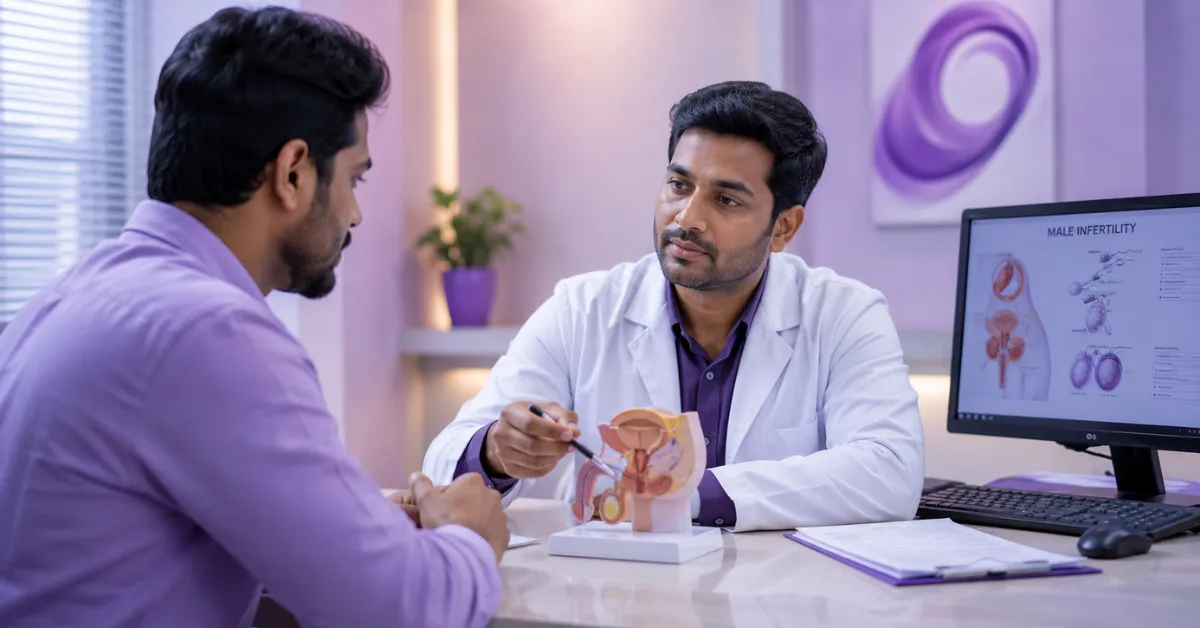
Male infertility means that a man has difficulty helping his partner get pregnant naturally. This is more common than most people think. Studies show that in about half of all infertility cases, the male partner plays a role.
The good news is that most causes of male infertility are treatable. With the right diagnosis and proper care, many men go on to father children successfully.
At THAAIMAI Hospital, we offer complete male infertility treatments in Chennai in a private, respectful, and supportive environment. We believe every couple deserves honest answers and the best possible chance at parenthood.
Male infertility can happen for many reasons. Some causes are physical, some are hormonal, and some are related to daily habits. Understanding the cause is the first step toward the right treatment.
Common causes include:
Some men also face infertility due to past surgeries, injuries, or long-term use of certain medications.
In most cases, male infertility does not cause any obvious symptoms. A man may feel completely healthy and still have a fertility issue. This is why testing is so important when a couple is trying to conceive.
However, in some situations, there are signs worth paying attention to:
If you and your partner have been trying to conceive for 12 months or more without success, it is a good time to seek help. If the woman is above 35, seeking advice after 6 months is advisable. Our specialists at THAAIMAI Hospital welcome you with no judgment and full confidentiality.
Before any treatment begins, our doctors take time to understand your full health history and run the right tests. Accurate diagnosis is the foundation of successful male infertility treatment.
At THAAIMAI Hospital, our diagnostic process includes:
Each test result is explained to you in simple, clear language. We do not rush through the process. You will always know what the results mean and what the next step is.
Many cases of male infertility can be treated without any surgery. Depending on what is causing the problem, our doctors may recommend one or more of the following approaches.
Non-surgical treatments are often the starting point. They are safe, effective for many men, and give good results when the cause is identified early.
When a physical problem is blocking sperm or reducing sperm production, surgery may be the right solution. Our experienced surgical team performs these procedures with precision and care.
Varicocelectomy Varicocele is one of the most common and treatable causes of male infertility. In this surgery, the swollen veins in the scrotum are tied off or sealed. This improves blood flow, reduces heat, and often results in better sperm count and quality within a few months.
Vasectomy Reversal (Vasovasostomy / Vasoepididymostomy) For men who had a vasectomy in the past and now wish to have children, reconnection surgery can restore sperm flow. The success depends on how long ago the vasectomy was done and the condition of the reproductive tract.
Sperm Retrieval Procedures When sperm cannot be ejaculated due to a blockage or production issue, sperm can be collected directly from the reproductive organs through procedures such as:
These sperm retrieval methods are done under local or short general anesthesia and are minimally invasive. The retrieved sperm is then used in IVF or ICSI treatment.
Transurethral Resection of Ejaculatory Ducts (TURED) When the ejaculatory ducts are blocked, this procedure opens them up so sperm can flow normally.
All surgical treatments at THAAIMAI Hospital, the trusted male infertility treatments hospital in Alwarpet, are done with full safety protocols, experienced surgeons, and careful aftercare.
When natural conception is not possible even after treatment, Assisted Reproductive Techniques help couples achieve pregnancy using advanced medical methods. At THAAIMAI Hospital, we offer a full range of ART options.
Intrauterine Insemination (IUI) In IUI, carefully prepared sperm is placed directly into the woman's uterus at the time of ovulation. This shortens the distance sperm needs to travel and increases the chance of fertilization. IUI works well for men with mild sperm problems.
In Vitro Fertilization (IVF) IVF involves collecting eggs from the woman and fertilizing them with sperm in a lab. The resulting embryo is then placed back into the uterus. IVF is a well-established treatment with strong success rates for many types of infertility.
Intracytoplasmic Sperm Injection (ICSI) ICSI is a specialized form of IVF where a single sperm is injected directly into the egg. This is particularly useful when:
ICSI has helped many couples where the male partner has severe fertility issues. It is one of the most effective tools we have at THAAIMAI Hospital for male infertility treatment in Chennai.
For complex cases or situations where standard treatments have not worked, advanced options are available at THAAIMAI Hospital.
Each advanced treatment path is discussed honestly and openly with you. Our doctors at THAAIMAI Hospital take time to explain what is realistic so you can make decisions with confidence.
Alongside medical treatment, healthy daily habits play a real role in improving sperm health and overall fertility. Small consistent changes can make a meaningful difference.
Our team at THAAIMAI Hospital guides you on practical lifestyle changes that suit your actual routine. We do not give generic advice. We understand your life and give support that fits.
Dealing with male infertility is not just a physical challenge. It can affect how a man feels about himself and how a couple relates to each other. This is completely normal, and it is something we take seriously at THAAIMAI Hospital.
Many men feel alone in this experience because fertility challenges are not often talked about openly. Feelings of guilt, frustration, sadness, or anxiety are common — and they deserve proper attention alongside medical treatment.
What Our Counseling Support Includes:
Seeking emotional support during fertility treatment is not a sign of weakness. It is a smart and caring thing to do for yourself and your relationship. At THAAIMAI Hospital, we see the whole person — not just the test results.
THAAIMAI Hospital is a trusted name for male infertility treatments in Chennai, with a dedicated team that combines medical expertise with genuine human care.
Whether you are just beginning to explore your options or have already tried other treatments, THAAIMAI Hospital welcomes you with the care and attention you deserve.
Male infertility is more common than many realize, but with today's advanced medical treatments, it is largely manageable. From medications and lifestyle changes to surgical procedures and assisted reproductive techniques, there is a solution for almost every cause.
Early diagnosis and the right medical guidance are the most important steps a couple can take. At THAAIMAI Hospital, every patient receives personalized care, honest guidance, and compassionate support — because every couple deserves the best possible chance at building the family they dream of.
Yes, it is more common than most people realize. About one in six couples face difficulty conceiving, and in roughly half those cases, a male fertility issue plays a role. You are not alone, and treatment is available.
It depends on the cause and treatment chosen. Some hormonal treatments take 3 to 6 months to show results in sperm quality. Surgical recovery is usually a few weeks. ART procedures follow their own timelines. Your doctor will give you a realistic timeframe after diagnosis.
These procedures are done under local or general anesthesia, so you will not feel pain during the procedure. There may be mild discomfort for a few days afterward, which is managed with simple pain relief.
For mild cases caused by stress, poor diet, or smoking, lifestyle improvements can make a significant positive difference. For moderate to severe cases, lifestyle changes support but do not replace medical treatment.
Absolutely. We maintain complete confidentiality for all patients. Your personal information, diagnosis, and treatment details are never shared without your permission.
Take the first step toward better women’s health. Book an appointment with Thaaimai Hospital for expert care, accurate diagnosis, and advanced treatments designed for safe recovery and long-term wellness.